
Lenoir County District Court
Lenoir County is part of the North Carolina Judicial Branch. The state structure map for this project identifies the primary trial-court name as Superior Court and District Court. Lenoir County belongs to Prosecutorial District 9, Superior Court District 9A, and District Court District 9. The county does not have a separate county court, justice court, or municipal court system comparable to states that route local cases through city or justice courts.
The local courthouse is the Lenoir County Courthouse at 130 S Queen Street, Kinston, NC 28501. The courthouse mailing address is PO Box 68, Kinston, NC 28501, and the main phone number is 252-520-5300. Posted hours are Monday through Friday, 8:00 a.m. to 5:00 p.m. The courthouse is the public access point for Superior Court, District Court, magistrates, the Clerk of Superior Court, estate filings, traffic and criminal matters, civil files, divorce judgments, docket questions, and certified court copies.
The official North Carolina courts overview explains the statewide trial and appellate court structure.
That state structure is the reason Lenoir County court cases route through state trial divisions rather than a local county-court system.
Lenoir County Courthouse
130 S Queen Street
Kinston, NC 28501
252-520-5300
Mail: PO Box 68, Kinston, NC 28501
Monday-Friday, 8:00 a.m.-5:00 p.m.
Lenoir County Trial Courts
North Carolina does not assign separate numbered district courts in Lenoir County the way some states assign numbered trial courts. The local table is therefore a division and role table, not a list of numbered county courts. Superior Court and District Court sit at the Lenoir County Courthouse, and magistrates operate within the District Court structure.
| Court Number | Trial Division or Officer | Address | Phone |
|---|---|---|---|
| Not numbered locally | Superior Court, District 9A | 130 S Queen Street, Kinston, NC 28501 | 252-520-5420 |
| Not numbered locally | District Court, District 9 | 130 S Queen Street, Kinston, NC 28501 | 919-722-6250 |
| Not a separate court | Magistrates within District Court | 130 S Queen Street, Kinston, NC 28501 | 252-520-5430 |
| Record custodian | Clerk of Superior Court | 130 S Queen Street, Kinston, NC 28501 | 252-520-5300 |
Lenoir County Superior Court
Superior Court is North Carolina's older trial division. In Lenoir County, Superior Court hears felony criminal cases, civil cases over $25,000, and appeals from District Court in criminal misdemeanor and infraction matters. Superior Court can also handle certain estate and special proceeding appeals, depending on the type of order and procedure involved.
The official North Carolina Superior Court overview explains statewide Superior Court jurisdiction and structure.
For Lenoir County record access, Superior Court files still route through the Clerk of Superior Court and the public case systems where records are available.
Lenoir County District Court
District Court handles many of the high-volume matters that residents see most often. In Lenoir County, District Court handles misdemeanors, infractions, traffic cases, juvenile matters, domestic cases, small claims appeals, and civil matters assigned to that division. The court also works with magistrates for front-end judicial functions such as warrants, initial appearances, small claims, and summary ejectment.
The official North Carolina District Court overview describes District Court jurisdiction and statewide structure.
Traffic cases, misdemeanors, domestic cases, juvenile matters, and lower civil matters should be understood as District Court work unless a specific case moves to Superior Court by appeal or jurisdiction.
District Court vs Lower Courts
Lenoir County does not have a separate county court or local justice court for ordinary court cases. Municipal law-enforcement agencies such as Kinston Police may create incident, arrest, crash, or investigative records, but the court case itself routes through the North Carolina state court system. Magistrates are judicial officers within District Court, not a separate court level.
| Point | Superior Court and District Court | County or Municipal Court | Magistrates |
|---|---|---|---|
| Local status | Main Lenoir County state trial divisions | No separate local court system for ordinary cases | Judicial officers within District Court |
| Civil role | Superior Court over $25,000; District Court lower civil matters and small-claims appeals | Not used as a separate Lenoir County case venue | Small claims and summary ejectment front-end work |
| Criminal role | Superior Court felonies; District Court misdemeanors, infractions, traffic, and preliminary matters | City police may create records, but cases route to state court | Warrants, initial appearances, bond, and criminal process |
| Record access | NC eCourts Portal, courthouse terminals, and Clerk of Superior Court | No separate city-court case search found | Contact magistrates or clerk for court-process direction |
Lenoir County Case Flow
Case flow depends on case type, but the same courthouse and clerk structure supports both Superior Court and District Court records. A criminal case may begin with a law-enforcement charge, warrant, magistrate order, citation, criminal summons, or indictment. District Court handles many early and lower-level proceedings, while felony trials and felony dispositions move through Superior Court.
Criminal flow: Arrest or citation › Magistrate or initial process › District Court hearing or felony screening › Superior Court indictment when applicable › Plea or trial › Disposition and sentence › Appeal where allowed.
Civil flow: Complaint or petition filed › Service › Answer or response › Motions or mediation where required › Hearing or trial › Judgment › Appeal where allowed.
Estate flow: Application at the clerk › Qualification or probate › Inventory › Notice and administration › Accounting and closing, with some disputes or appeals moving to a judge.
Lenoir County Courthouse Access
The courthouse page notes that the Lenoir County Small Claims Courtroom was relocated into the main courthouse. The small-claims courtroom is on the first floor in the former Lenoir County Commissioners Meeting Room, directly across from the District Attorney's Office and diagonally across from the courthouse Sheriff's Office. This matters for small claims, summary ejectment, and courthouse navigation.
Parking is listed at the back of the building. Courthouse access is on the right side of the building from the parking places where the magistrate office is located. No official parking fee schedule was found. Lenoir County Transit provides demand-response and subscription scheduling rather than a fixed courthouse bus route, and riders generally schedule in advance.
Note: Confirm courtroom location before arrival because small-claims and District Court settings can move by session.
Lenoir County Court Programs
The Lenoir County Judicial Branch page lists several court programs that may affect District Court and Superior Court users. These include Family Court Administration, Guardian ad Litem, Clerk Mediation Program, Family Financial Settlement Program, Juvenile Court Improvement Program, Child Custody and Visitation Mediation Program, and Court-Ordered Arbitration. Those programs are court services or process tracks, not separate courts.
Statewide North Carolina Recovery Courts are problem-solving courts designed for cases involving substance use, mental health, or co-occurring disorders. The research did not locate an official Lenoir-only recovery court page with local judge, eligibility rules, participant counts, graduation statistics, or a local operating manual.
Use local court contacts before assuming a specific recovery court program is available for a Lenoir County case.
District Court Records Search
Lenoir County went live on eCourts as part of Track 8 on April 28, 2025. Public case lookup, hearing search, and payment functions are available through the NC eCourts Portal when the record is public and indexed. Search by case number when possible, or use party names with location filters for Lenoir County. The Portal can show case type, status, parties, events, hearings, dispositions, public documents, and financial information where available.
The NC Judicial Branch announcement that eCourts is live in eastern counties including Lenoir County explains the local rollout.
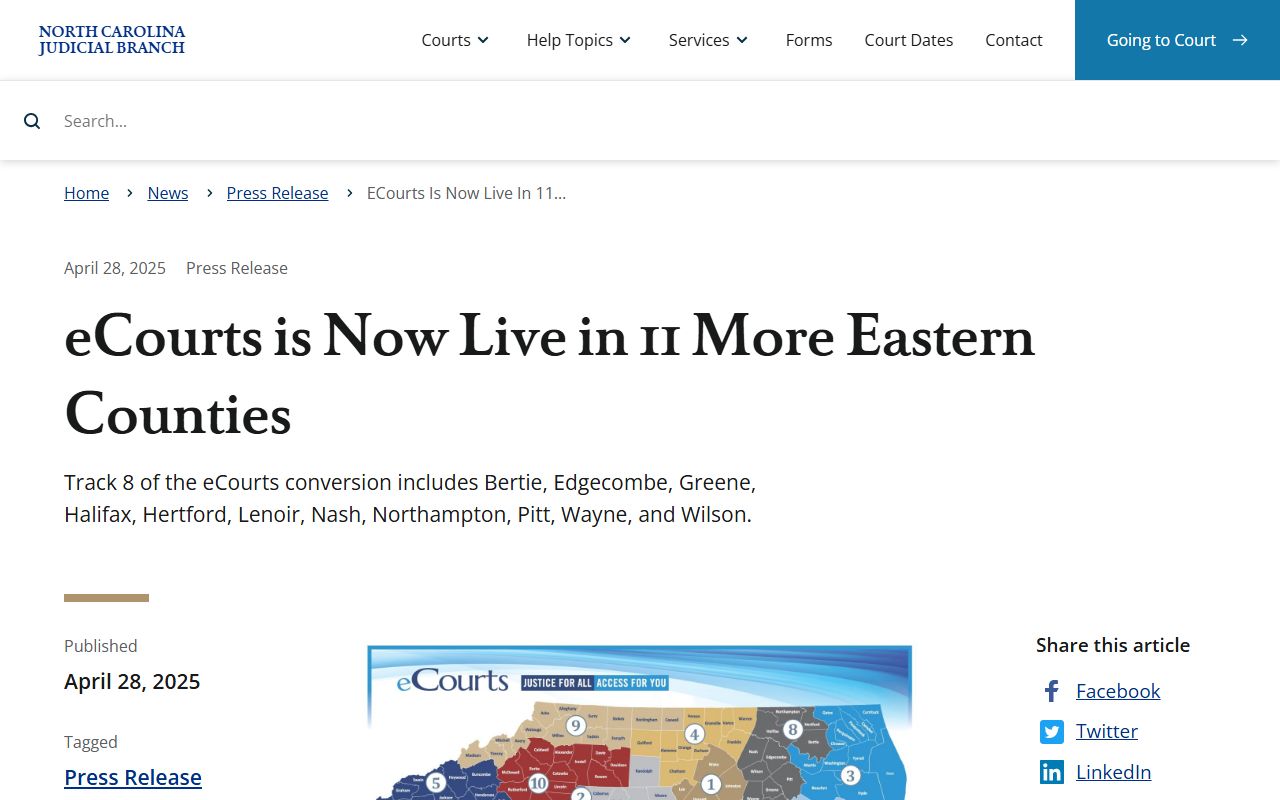
The rollout changed local access from mainly courthouse and paper workflows to Portal lookup plus clerk fallback for complete or certified records.
When a case is not visible online, use the Clerk of Superior Court for a terminal search, paper file request, certified copy, or restricted-access question. Portal access does not remove the clerk's role as record custodian.
District 9 Judicial News
Recent judicial appointment news affects the same regional District Court structure that serves Lenoir County. On March 31, 2025, Governor Josh Stein appointed Sonya Davis as District Court judge in Judicial District 9, serving Greene, Lenoir, and Wayne counties. The release says she filled the vacancy created by Judge Beth Heath's retirement and had experience in domestic matters, real estate, and criminal defense.
The official appointment release for District Court judges in Districts 8 and 9 provides the source for that update.
Judicial assignment news can help explain who serves the district, but case records and hearing details still come from official court lookup and clerk channels.
Appeals and Appellate Courts
Appeals from Lenoir County cases generally go through the North Carolina appellate system. The state court structure map identifies the North Carolina Court of Appeals as the appellate court, with the Supreme Court of North Carolina as the state's highest court. In criminal misdemeanor and infraction matters, District Court appeals can move to Superior Court first. Other appeals follow the rules for the case type and order being appealed.
The Clerk of Superior Court is still important after an appeal because the clerk maintains the local file, entries, judgments, notices, and transmitted records. For a local copy of a judgment or order, use the Lenoir County clerk. For appellate dockets or appellate opinions, search the state appellate systems.