
Lenoir County Clerk of Superior Court
North Carolina uses a unified Clerk of Superior Court model. Lenoir County does not split court records between a county clerk and a district clerk. The local court record custodian is the Lenoir County Clerk of Superior Court at the Lenoir County Courthouse. The current clerk identified in official state ethics and local materials is Mary G. Alphin. The office phone is 252-520-5300.
The courthouse address is 130 S Queen Street, Kinston, NC 28501, and courthouse mail goes to PO Box 68, Kinston, NC 28501. The posted courthouse hours are Monday through Friday, 8:00 a.m. to 5:00 p.m. The clerk's office is the practical source for certified copies, older paper files, estate records, sealed-record access questions, and case files not available through public online search.
The North Carolina Judicial Branch Lenoir County contact directory lists local court contacts for the clerk, judges, magistrates, District Attorney, and court programs.
Lenoir County Clerk of Superior Court
Clerk: Mary G. Alphin
130 S Queen Street
Kinston, NC 28501
252-520-5300
Mail: PO Box 68, Kinston, NC 28501
Monday-Friday, 8:00 a.m.-5:00 p.m.
What the Clerk Maintains
The Clerk of Superior Court maintains local Superior Court and District Court files. Those files can include civil actions, criminal case files, traffic and infraction records, domestic cases, divorce judgments, estate and probate files, special proceedings, small-claims appeals, judgments, liens, and court indexes. The clerk also acts as probate judge for estate administration.
Clerk records differ from sheriff and police files. Law enforcement can hold incident reports, arrest reports, crash reports, booking records, and investigative files. The clerk holds the court case file after a case enters the judicial system. For a full criminal case outcome, the clerk's file is the court record; for an arrest narrative or police report, the law-enforcement agency is the custodian.
- Civil case files, including complaints, answers, motions, orders, judgments, and notices.
- Criminal case files, including charges, warrants, pleas, dispositions, sentencing terms, and costs.
- Domestic and family files, including divorce judgments and certain custody or support records.
- Estate, probate, special proceeding, judgment, lien, and court-index records.
Lenoir County Clerk Access Channels
Public access starts with the NC eCourts Portal when the case information is online and public. Lenoir County went live on eCourts as part of Track 8 on April 28, 2025, so Portal access is now part of the local record workflow. Portal results can be filtered by location and may show case details, hearings, public documents, financials, and payment eligibility.
The clerk remains the fallback when online access is incomplete. The North Carolina Judicial Branch says public self-service terminals in a clerk's office can provide criminal case information searchable by defendant name, case number, victim name, or witness name. Paper files can be accessed at the clerk's office in the county where the case is located. Civil, special proceeding, and estate information can also be accessed through clerk public terminals and/or Portal.
| Channel | Use | Contact or Location |
|---|---|---|
| Online Portal | Public case search, hearing search, judgments, payments | NC eCourts Portal |
| In person | Paper files, public terminals, certified copies | 130 S Queen Street, Kinston |
| Phone | Clerk record questions | 252-520-5300 |
| Written clerk requests and mailed copy matters | PO Box 68, Kinston, NC 28501 |
Request Certified Court Copies
A certified copy is a copy authenticated by the clerk as an official court copy. Certified copies are often needed for appeals, name changes, licensing matters, benefits files, record correction, real estate or title issues, and proof of a final judgment. Portal printouts and screenshots are not certified copies.
- Identify the case type, case number if known, party names, and the specific document needed.
- Search the NC eCourts Portal or clerk terminal first if the case number is unknown.
- Contact the Lenoir County Clerk of Superior Court at 252-520-5300 or visit the courthouse in Kinston.
- Ask for certified copies and confirm the copy, certification, and mailing fees before payment.
- Review the certified copy to make sure the clerk certification and correct document are included.
The statewide obtaining court records guidance explains the difference between online access, public terminals, paper files, and clerk copies.
Clerk Request Fields
Lenoir County court-copy requests work best when the request identifies the case and document with enough detail for staff to find the file. The research did not identify a separate Lenoir-specific clerk copy form. Use the common court-record request details below when calling, mailing, or visiting.
| Field | Required | Notes |
|---|---|---|
| Case number | Helpful when known | Portal and clerk indexes can help locate it |
| Party names | Yes | Use full legal names and date range when possible |
| Case type | Yes | Civil, criminal, traffic, domestic, estate, special proceeding |
| Document type | Yes | Judgment, order, divorce decree, letters, inventory, docket entry, or full file |
| Certified or plain copy | Yes | Certified copies carry clerk authentication |
| Delivery and contact details | Yes | Phone, mailing address, and payment method may be needed |
Lenoir County Clerk Fees
Clerk fees follow statewide North Carolina court fee statutes and charts. The research points to the court-cost resources and the clerk fee statute, not a separate local Lenoir County fee schedule. Fees may depend on case type, copy count, certification, service, filing, and whether the request is part of a new case or an existing file.
The official North Carolina court costs page is the current statewide source for court cost charts and fee resources.
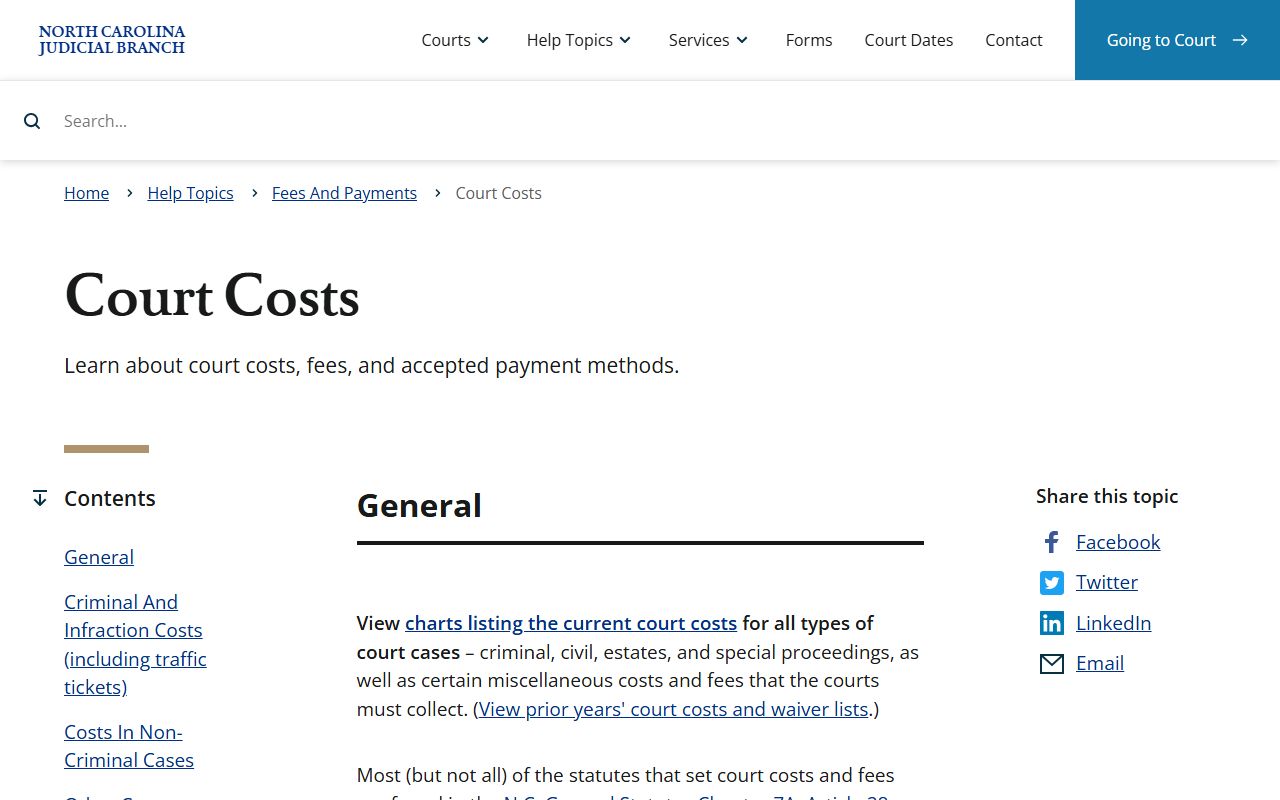
Use that fee resource with the Lenoir County Clerk of Superior Court because the same statewide cost framework applies locally.
| Clerk Fee Area | Source or Rule |
|---|---|
| Certified court copies | Request through Clerk of Superior Court; statewide fee law applies |
| Civil filing costs | State court cost charts |
| Estate filing costs | State estates cost chart and gross estate fee rules |
| Sheriff service | Statewide civil process service fee where service is needed |
| Traffic and criminal costs | State court cost charts and judgment entries |
Clerk Record Law
North Carolina law directs clerks to keep court records, files, dockets, indexes, judgments, and related records. The clerk record-keeping statute is especially important in Lenoir County because the clerk is the record custodian for Superior Court and District Court files. Court records are not handled by a county manager, Register of Deeds, sheriff, or city police department once the record is a court file.
The official North Carolina General Assembly page for NC Gen. Stat. 7A-109 is the record-keeping statute source.
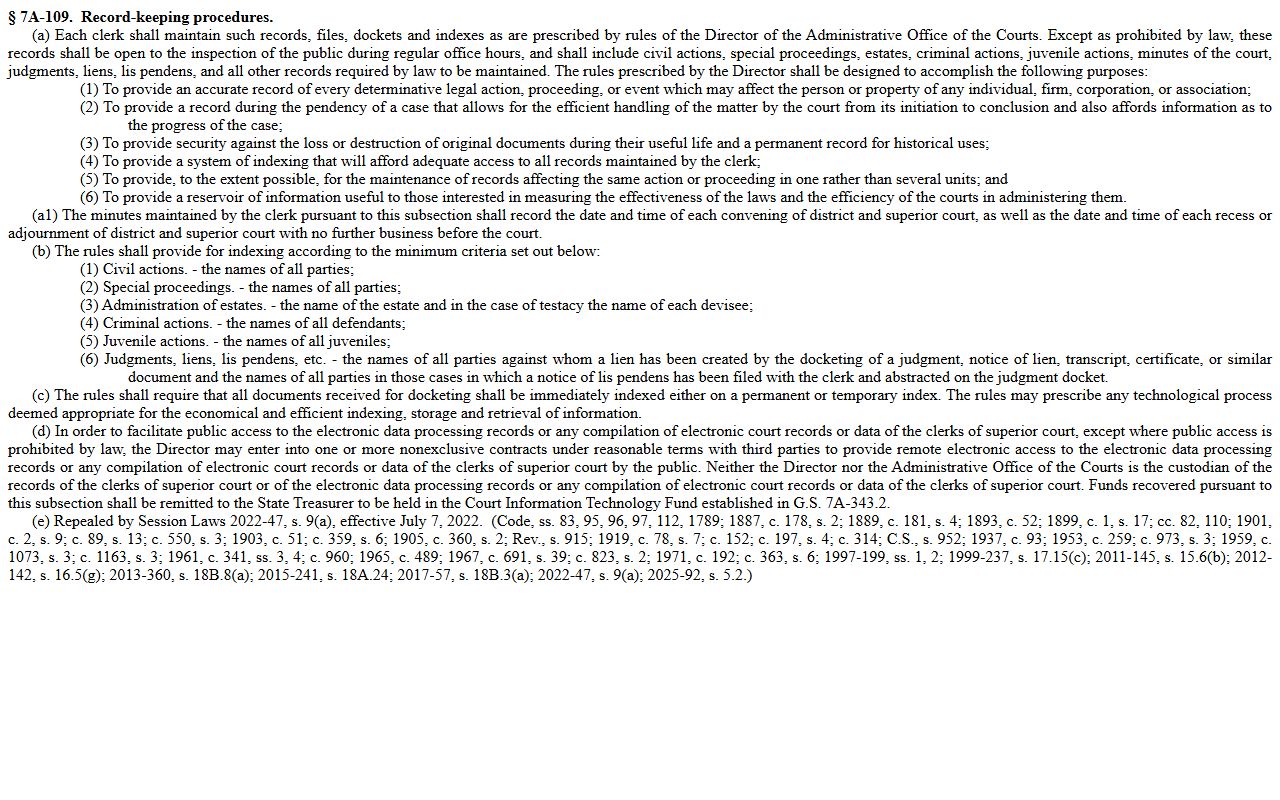
That statute supports the local clerk role for indexes, dockets, judgments, and the case papers tied to Lenoir County court files.
The clerk fee statute, NC Gen. Stat. 7A-308, is the source for many copy, certification, and miscellaneous clerk fees.
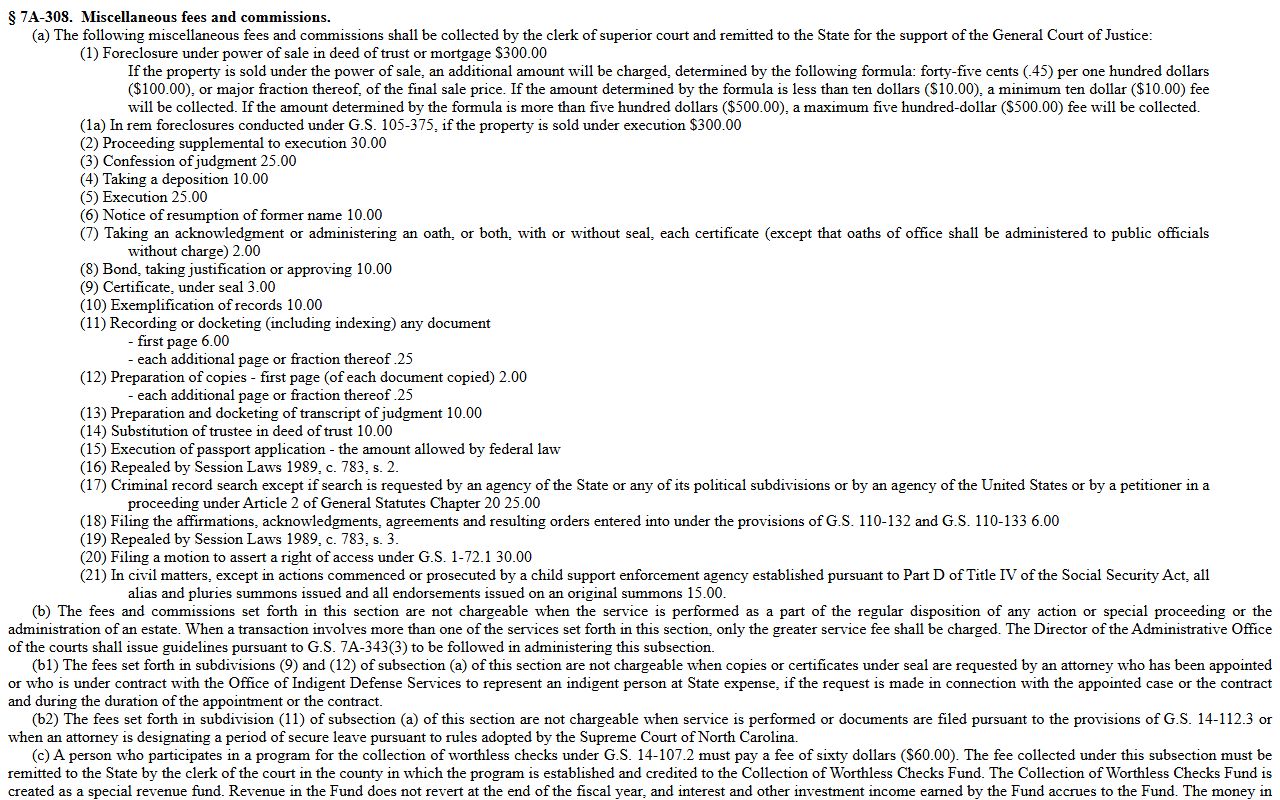
Because fees are set at the state level, a Lenoir County request should use current statewide fee rules rather than an assumed local price.
Public Access and Limits
North Carolina public records are generally open unless a statute creates an exception, but court records have their own rules, sealed-record orders, confidential case types, and redaction practices. Adult civil and criminal records may be public unless sealed, expunged, restricted by statute, or restricted by court order. Juvenile, adoption, mental-health, protected personal data, and some family or protective-order materials may be confidential or redacted.
The North Carolina Public Records Act chapter is available through the General Assembly's Chapter 132 public records statute page.
For Lenoir County court files, public-records principles must be read with court-specific access rules and confidentiality statutes.
Note: A missing Portal result does not prove a Lenoir County court file is unavailable.
Register of Deeds Difference
The Lenoir County Register of Deeds is not the court clerk. It handles land records, real estate transactions, maps, assumed names, notaries, military discharges, marriage licenses, marriage certificates, birth certificates, and death certificates. That office is at 101 North Queen Street, Kinston, NC 28501, with phone 252-559-6420 and email lcrod@lenoircountync.gov.
The official Lenoir County Register of Deeds page shows the separate office, staff, vital-record links, fees, and recording information.
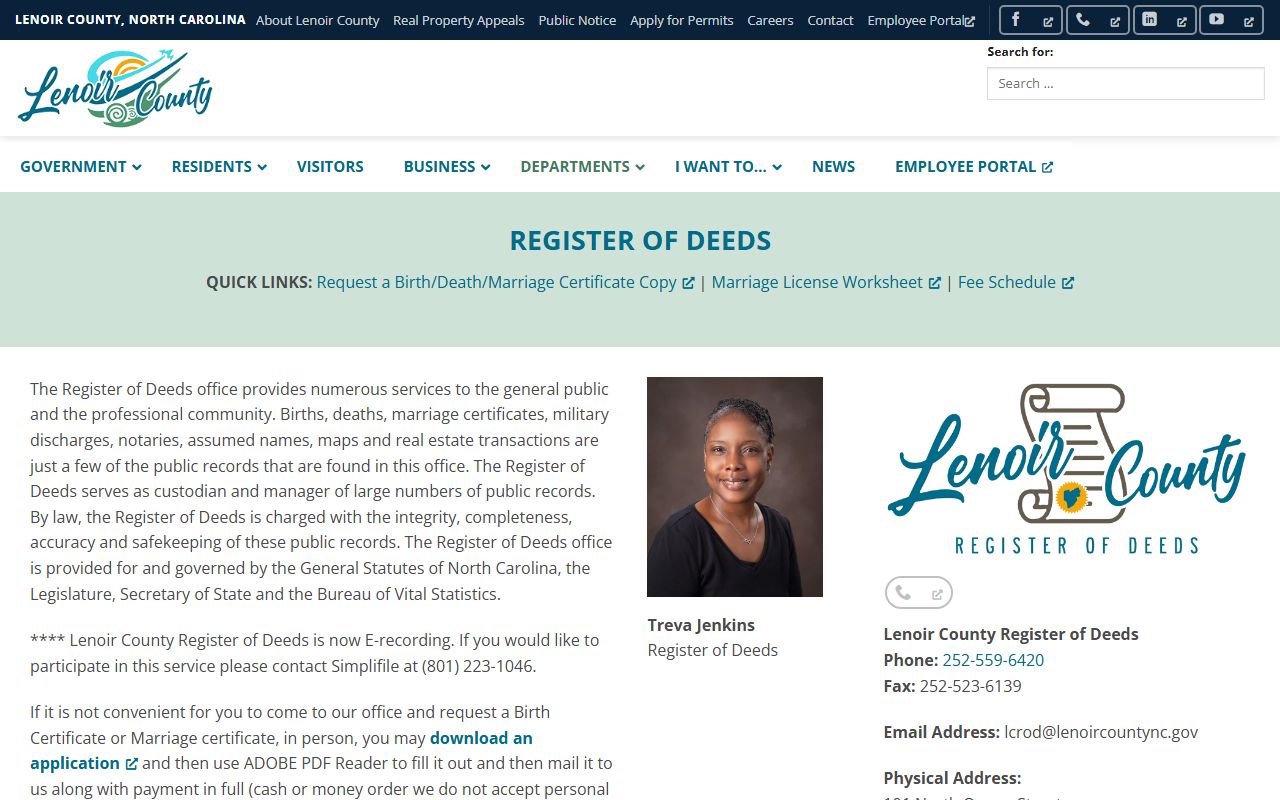
Use the Register of Deeds for marriage certificates and land records, and use the Clerk of Superior Court for Lenoir County court records and estate files.
Lenoir County Court Contacts
The contact directory gives useful routing numbers beyond the clerk. Superior Court Judges are listed at 252-520-5420. District Court Judges are listed at 919-722-6250. Magistrates are listed at 252-520-5430. The District Attorney local number is 252-520-5400. Guardian ad Litem is listed at 919-722-6300. Custody Mediation and Family Court are listed at 919-722-6260, and Court-Ordered Arbitration is listed at 919-722-6266.
Those offices may handle scheduling, program, prosecution, mediation, or judicial questions, but the court file itself still routes through the clerk. When the task is a certified copy, case file, public terminal search, estate filing, or old paper record, start with the Clerk of Superior Court.